Methods and Preliminary Results
The primary goal for a database of stable isotope ratios is creating discrete regions on a plot that correspond to each quarry. i.e. if the isotope ratio from a newly-examined artwork falls within a region, the artwork has a probability of coming from that site. The statistics behind this is somewhat opaque for audiences that do not intend to crunch the data themselves, but for the sake of transparency, I will note my process. I have drawn the discrete regions as 95% confidence ellipses using XLSTAT (a statistics plug-in for Microsoft Excel) and can be created in most statistics packages.[1] The close the data from a new artwork is to the center of a quarry's ellipse, the higher its probability of coming from the quarry.
I had originally intended to construct the ellipses in the open source statistics package R, but I had issues that I only later discovered stemmed from using the beta version of rstudio.cloud. This web-based platform for using R could not install the 'car' (Companion to Applied Regression) package that can be used for constructing confidence ellipses.
The immediate impression when viewing the visualized data (see below) is likely confusion. The regions are not discrete – they overlap, and are clustered around the center. Even when controlling for other variables, they overlap to the point that we cannot differentiate between most quarries. This problem has been developing for nearly two decades as scientists have collected more data, and many have attempted to resolve the issue by including more variables such as maximum grain size and trace elements.[2] The Harvard marbles, however, have only stable isotope ratios for all but one piece. The Running Boy is the only piece at Harvard that has been studied to contemporary standards – it was particularly important for this object because pieces of it were originally believed to be made of Carrara marble, when in fact they came from Göktepe. These two sites produce marble that is visually and isotopically similar – they must be differentiated by trace element analysis, particularly strontium content.[3]
Going forward, this project will investigate whether we can identify the provenance of the Harvard artworks, or only prove that the current attributions need further study.
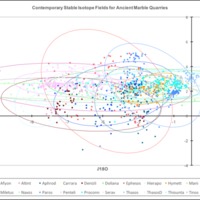
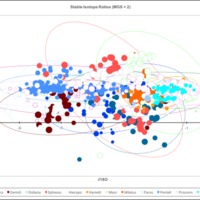
I performed several exploratory analyses to test the dataset against well-established assumptions about marble. First, I looked at the proportion of dolomite i nmarble. Only stone from the Cape Vathy quarry on the island Thasos is pure dolomite - the data supports this. In fact, the two sites of Thasian marble are labeled in the dataset as "Thasos" and "ThasosD," with the latter referring to Cape Vathy marble.

This plot shows the raw stable isotope data for each quarry. Ideally, the points would form discrete clusters, but it is clearly packed around a area between (-4,2) to (0,2). Click on the quarry names in the right-hand legend to see how much the stable isotope ratios vary within one quarry.
The Paros quarry, for example, has an extreme outlier at (-2.541, -5.14) – click on the name Paros in the legend to see the points. Not only does that stretch out the confidence region, that point raises the issue that any mistake in quarry attribution of samples will confuse later analyses. In this specific sample's case, it likely was in fact taken from Paros because it was done by Attanasio's collaborator Matthias Bruno (Attanasio's data lists information from the sampling process), but then we must ask whether this data is still useful.

Other variables are useful both by themselves and when added to other parameters. Below are two visualizations of the maximum grain size of marble by individual sample and on average. Note how large grain Naxian marble can be as well as the difference between dolomitic and calcitic marble from Thasos. This agrees with descriptions of dolomitic marble as "sugary" – the fine texture is due to small grain size.

Lastly, the whiteness of each marble provides another easily measurable and useful value. Again, the data agrees with previous results: dolomitic marble like Thasian is the most brilliantly white, followed by some of the other fine marbles from Carrara, Paros, and Mt. Pentelicus.

[1] See Herz and Wenner 1981.
[2] See Thomas Cramer’s 2004 dissertation “Multivariate Herkunftsanalyse von Marmor auf petrographischer und geochemischer Basis: Das Beispiel kleinasiatischer archaischer, hellenistischer und römischer Marmorobjekte der Berliner Antikensammlung und ihre Zuordnung zu mediterranen und anatolischen Marmorlagerstätten” for an in-depth treatment of the topic. The piece includes abstracts in both English and Spanish.
[3] “Multimethod Provenance Analyses of White Marbles – the Carrara-Göktepe Entanglement,” ResearchGate, accessed May 23, 2017, https://www.researchgate.net/publication/283080986_Multimethod_provenance_analyses_of_white_marbles_-_the_Carrara-Goktepe_entanglement.