Key Ancient Quarries
A number of ancient quarries were developed in locations near major construction sites and in places containing the highest-quality stone. In the Archaic period (ca. eighth century BCE to 480 BCE), the few known quarries were confined to the Greek mainland and islands. By the Classical period (ca. fifth century BCE to fourth century BCE, often considered ended by the death of Alexander the Great in 323 BCE) more large structures were built that required large supplies of marble. The Parthenon in Athens was built mainly between 447–438 BCE using marble from the nearby Mt. Pentelikon (called Mount Pentelicus on the map below), and the Temple of Poseidon in Sounion was built from local marble (sometimes called Agrileza marble). In the Hellenistic period (ca. 323 BCE to 31 BCE), the number and geographic spread of marble quarries expanded greatly as Greek city-states spread across the Mediterranean into modern Turkey. Finally, after Rome conquered much of Greece, the expansion and unification of trade led to the development of many more quarries and increased movement of marble.[1]
The Roman marble trade raised controversy: what role did the Roman road system play in the marble trade? Do we see a demonstrable increase in movement of ancient marble in this period? Some scholars have claimed that the enormous increase in marble consumption in the Roman period led to quarries preparing blocks in standardized sizes to be sent out when new commissions came in (it is believed that prior to this, marble quarrying was done on a per job basis).[2]
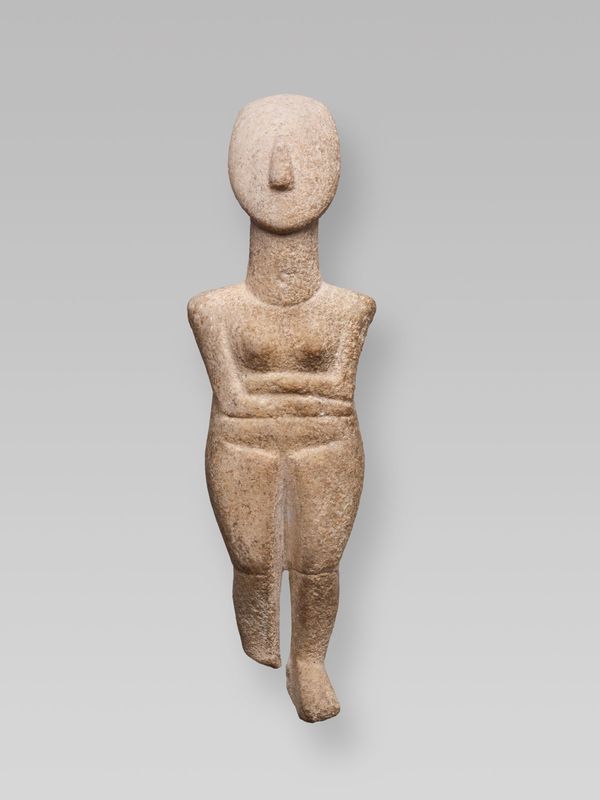
Lastly, it is worth noting the difficulty of tracing marble from before the Archaic period. Some marble artworks predate Greek civilization entirely. A key example are the Cycladic figurines, a series of small, enigmatic anthropomorphic sculptures from the Cyclades, a group of islands southeast of mainland Greece. Because there were no quarries before the Archaic period, scientists hoping to compile a database of marble to determine the source of the Cycladic figurines’ marble would need to sample every outcropping of marble they found. (The figurines are very small, only a few inches long, so they could be made from almost any block of stone.) Research began on the largest Cycladic island, Naxos, and the initial analysis showed it to be the likely source of all the figurines, but the task was still difficult.[3]
The map below shows some of the best-known quarries in the ancient world. Though many smaller quarries existed, and some large quarries have been recently discovered, this list is a sample of some of the most famous sources of marble that feature prominently in contemporary scholarship. Click on the red location markers for the quarry's name and description.
Note: This map draws heavily from the J.B. Ward-Perkins Memorial Volume (see footnote [1]). Though Ward-Perkins and Dodge separate the quarries by Greek and Roman, well over half of the quarries were used in both periods, and the dating is still speculative in many cases. For those reasons, I created a single map of the major Greco-Roman quarries.
[1] For a map of ancient quarries focusing on Rome, see: Bryan Ward-Perkins and Hazel Dodge, Marble in Antiquity: Collected Papers of J.B. Ward-Perkins, Archaeological Monographs of the British School at Rome; No. 6 (London: British School at Rome, 1992), 152-154. For a map of quarries in Greece and Asia Minor see ibid. 155-159. Other more recent studies can be found in the more recent publications of ASMOSIA (see bibliography), but they tend to be focused on specific regions rather than efforts to catalogue all marble quarries.
[2] For a nuanced treatment of the question of the Roman marble trade see: Martin Maischberger, Marmor in Rom: Anlieferung, Lager- und Werkplätze in der Kaiserzeit, Palilia ; Bd. 1 (Wiesbaden: Dr Ludwig Reichert Verlag, 1997).
[3] Dimitris Tambakopoulos and Yannis Maniatis, "The Marble of The Cyclades and Its Use In The Early Bronze Age," in Early Cycladic Sculpture in Context, edited by Marthari Marisa, Renfrew Colin, and Boyd Michael J., (Oxford; Philadelphia: Oxbow Books, 2017), 468-82 and interview with Yannis Maniatis and Dimitris Tambakopoulos, 29 May 2017.
[4] Interview with Yannis Maniatis, 29 May 2017.