Results from Analyzing Harvard's Marbles
The goal of this project is to not only provide a digital resource for understanding the results from marble provenance studies, it is also to present the results of my study of the Harvard Art Museums’ ancient marble artworks. I mapped the data from 38 different samples, coming from 25 artworks, against the quarry fields I had created. Unfortunately, XLSTAT (or possibly Excel) caused an unforeseen issue: I could not color-code the final quarries using the same scheme as my other visualizations once I added the data points from the artworks. The final results from my analysis are unsurprising in light of the preliminary work with Attanasio’s database: none of the artworks can be matched to a single quarry.
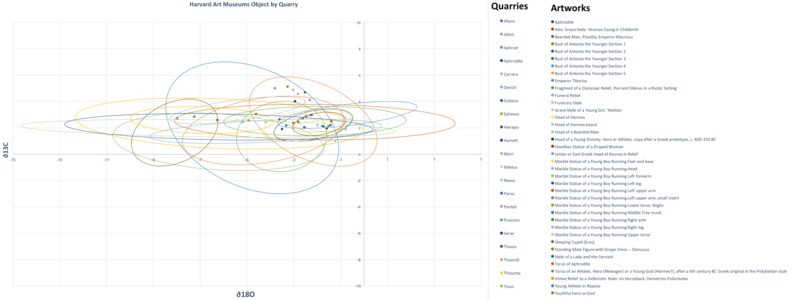
What does this mean for the Harvard Art Museums? A comparison of the current official attributions shows that they are not necessarily incorrect – for example, the Young Hero of God (formerly Meleager, object 1926.48) falls nearly in the center of the Parian region. That area, however, overlaps with most other quarries. Only pieces in the extremes of the ellipses could potentially be clearly attributed to one quarry using only stable isotope ratios, but the further they are from the center, the lower the probability that piece actually came from that quarry. At the very least, the current attributions of most pieces need to note the date of their provenance determination, as my contemporary analysis has shown the attributions are now inconclusive.
The only piece that has data available besides stable isotope ratios is the Marble Statue of A Young Boy Running (object 1999.231). It is amongst the most recently-studied artworks at the museum – Donatto Attanasio, John Herrmann, and Amy Jones published on the piece in 2010. Their work updated Jones’ original research that showed the artwork was a pastiche, and with the newfound knowledge of the Göktepe quarry, it became clear that the piece used Parian, Carrara, and Göktepe marble (rather than just Parian and Carrara).[1] Attanasio used EPR, color, and maximum grain size in addition to the standard stable isotope ratios.
While EPR data is available in Attanasio’s database, the Harvard objects (excluding the Running Boy) only have stable isotope ratios on record. Some ambiguous attributions have been clarified using other parameters, but none provide data that can be incorporated into quantitative methods.[2] The Meleager, for instance, was attributed to many different quarries in the 1995 ASMOSIA III proceedings, but the ultimate source was determined to be Paros due to the coarse grain and calcite content identified using x-ray diffraction.
Ultimately, multivariate analyses are necessary to determine the quarry of origin for marble. This will entail increased costs for museums testing their artworks and, in some cases, will require larger samples. Stable isotope analysis requires 20-100 mg of marble that can be drilled from broken surfaces, but other analytical methods that rely on crystal structure (especially petrographic research) require an intact chip from a broken surface. Taking samples has always been more difficult for sculpture than architecture, especially small artworks, and more intensive analyses will require larger samples. The minimum sample size sufficient for fluid inclusion chemistry is about 500 mg, which may not be feasible to take from all artworks.
Ancient stone will continue to capture the minds of scholars, artists, and viewers alike – this project will likewise continue to evolve to provide digital resources for interpreting new and old studies of marble.
[1] Amy Jones, ed., Teaching with Objects: The Curatorial Legacy of David Gordon Mitten (Cambridge, Mass.: New York: Harvard Art Museum; Distributed by ACC Distribution, 2010), 60.
[2] Nikolaas van der Merwe et al., “Stable Carbon and Oxygen Isotope Source Tracing of Marble Sculptures in the Museum of Fine Arts, Boston and the Sackler Museum, Harvard,” in Association for the Study of Marble and Other Stones used in Antiquity. International Symposium, The Study of Marble and Other Stones Used in Antiquity (London: Archetype, 1995), 187-197.